
April 29th, 2026
Theta Informatics LLC today announced its recent successful performance for the U.S. Army Concept Focused Warfighting Experiment, Cross Domain Fires (CFWE – CDF) experiment at U.S. Army Fort Sill, OK
Throughout several weeks of experimentation in February and March 2026, several Army soldiers of 13A (Field Artillery generalist) and 13F (Fire Support Specialist) military occupational specialties successfully trained on and operated a Skydio X10D sUAS (drone) and Theta’s OpenAthena for Android and OpenAthena Desktop software. Silvus Technologies provided multiple Streamcaster radios for the experiment, which integrated successfully with the OpenAthena software and enabled voice comms and network connectivity throughout the experiment.
Army soldiers used the drone and OpenAthena software to remotely detect, geolocate, and label ground objects of interest in a range complex on Fort Sill and perform simulated call for fire workflows from indirect fire field artillery assets. The experiment demonstrated interoperability of Theta’s OpenAthena software with Army mission command and Advanced Field Artillery Tactical Data System (AFATDS) software, constituting a proof-of-concept for a complete sensor-to-shooter kill chain using drones with just passive optical cameras.
Army operators developed new tactics, techniques, and procedures (TTPs) for employment of the OpenAthena software’s terrain-raycast technology for sUAS and provided critical feedback for improving the software for their use cases.
The demonstration paves the way for increased human machine integration and human machine teaming (HMI/HMT) for the Army, using attritable and inexpensive drone platforms to increase the safety, effectiveness, and lethality of its forward observers in large scale combat operations (LSCO) against a near-peer adversary.
Field artillery, known to Army warfighters as the king of battle, has accounted for upwards of 70% of combat casualties in both historical and contemporary high-intensity conflict. The accuracy and effectiveness of indirect fires from U.S. Army field artillery (where the gun line and target are not connected by line of sight) are dependent on forward observers (FO), who support maneuver forces and serve as the critical eyes and ears of field artillery. Despite the importance of the FO role, it remains a highly dangerous one given that FOs typically operate close to the front line and are a high priority target to the enemy. The use of drones and the OpenAthena software’s terrain-raycast technique allows forward observers to operate at increased standoff range from highly-dangerous frontline conditions.
Since the start of the full scale invasion by Russia of Ukraine in 2022, the Armed Forces of Ukraine has routinely demonstrated the use of drones instead of direct contact by infantry forces to observe for field artillery. In the 2022 Battle of the Siverski Donets, a Ukrainian soldier’s use of a consumer-grade sUAS for artillery forward observation against an attempted river crossing by Russian forces resulted in the destruction of over 485 Russian soldiers and 80+ vehicles. This scenario has played out repeatedly throughout the war, where use of drones for artillery observation and new tactics such as hunter-killer drone teaming now account for roughly 90% of Russian combat casualties.
Theta Informatics believes its successful experiment performance at Fort Sill contributes to Army Transformation and Training Command’s (T2COM) modernization objectives for the changing character of warfare. This experiment contributes to the aims of efforts including the Army Transformation Initiative (ATI) as well as American “drone dominance” as described by memos issued by the President of the United States and Secretary of Defense.
Following recent execution of a Collaborative Research and Development Agreement (CRADA) with DEVCOM Army Research Laboratory and several private partnerships with industry, Theta plans to capitalize upon this success by applying the OpenAthena software’s terrain-raycast technology for sUAS into fieldable capabilities for U.S. and allied warfighters.
Images:
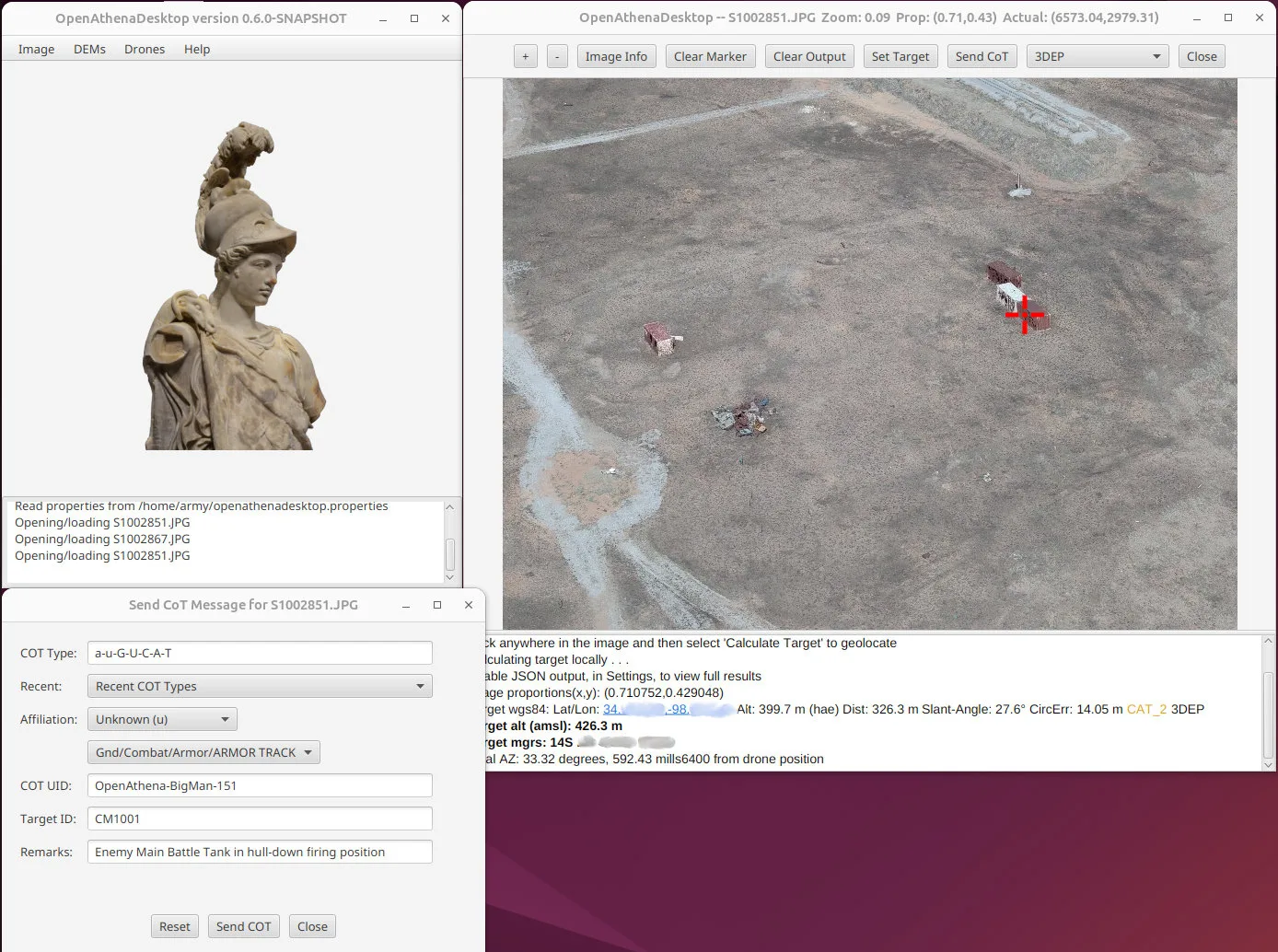
Figure 1: A drone image (including embedded position and orientation metadata) is loaded by an Army operator into the OpenAthena Desktop software’s user interface. The operator selects a target from a single pixel within the drone image, whereupon the OpenAthena software instantly calculates its ground location using the software’s terrain-raycast algorithm.
The operator is able to set the target’s allegiance, type, and a target ID before transmitting it to other units using the Cursor on Target (CoT) network protocol.
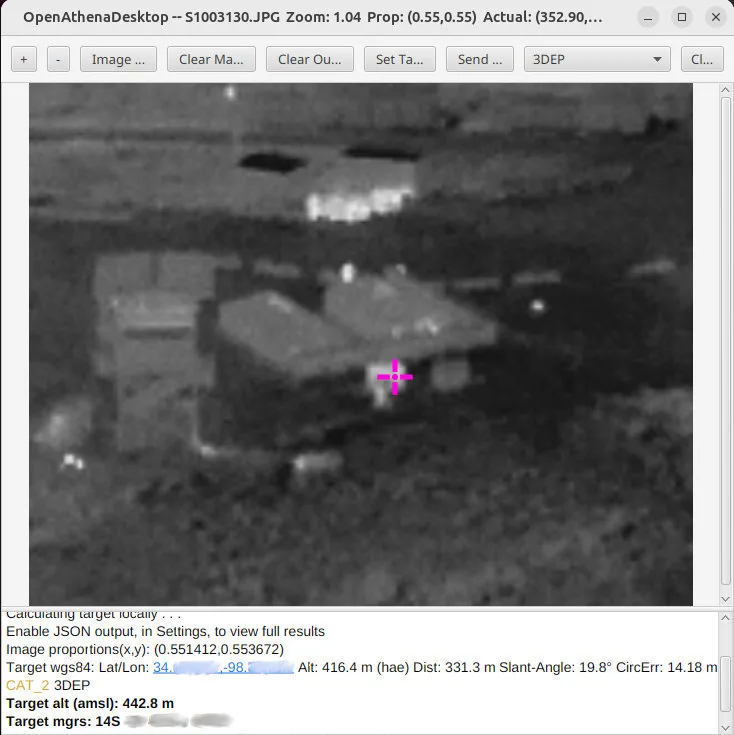
Figure 2: An image from the Skydio X10D’s Infared (IR) camera is loaded into OpenAthena Desktop. The operator uses the software to obtain target coordinates from the heat signature of a diesel generator
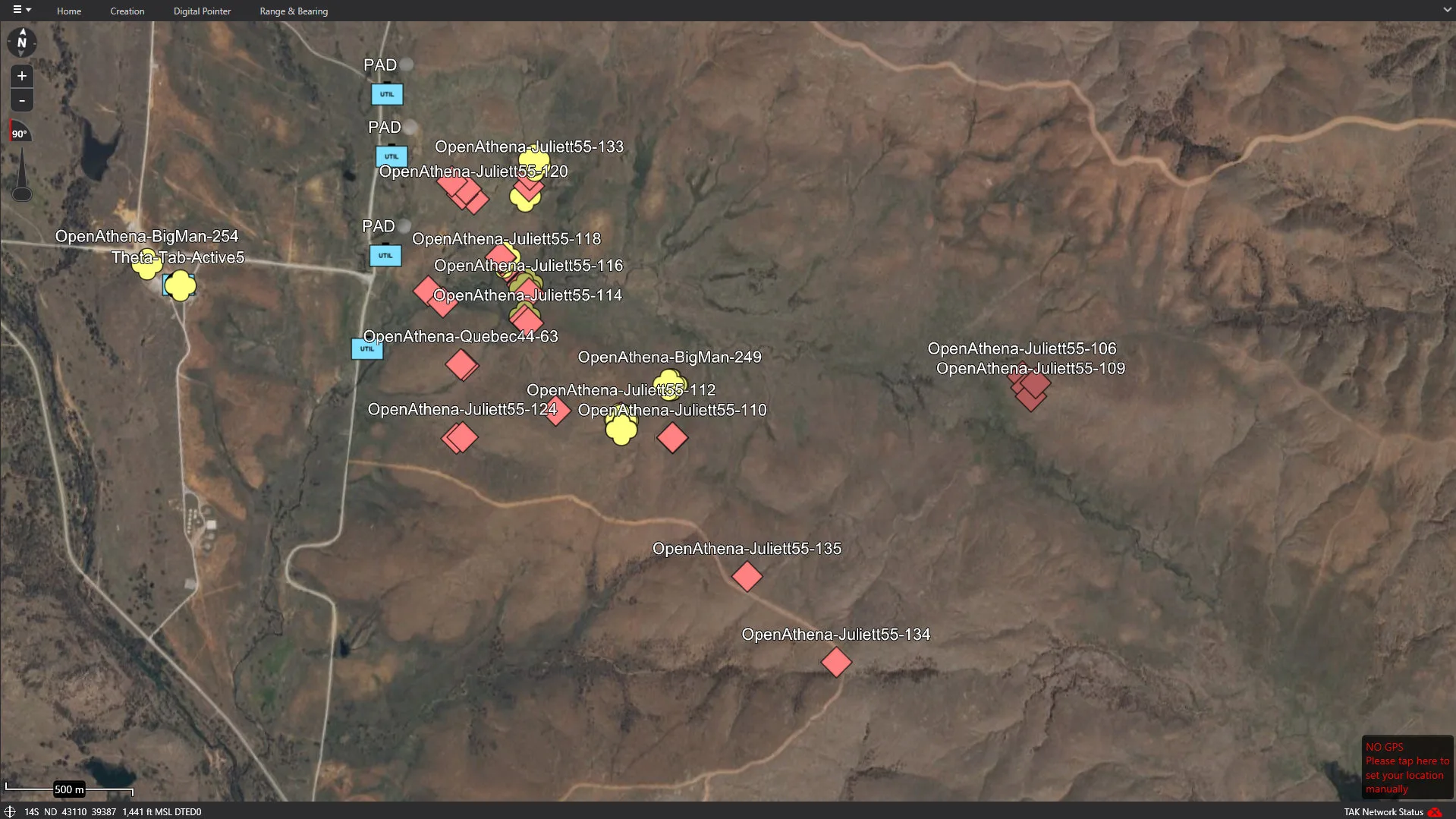
Figure 3: Multiple targets calculated by OpenAthena Desktop and Android applications are transmitted and displayed on the Android Team Awareness Kit (ATAK) map interface.
Team Awareness Kit (TAK) is a suite of software produced and distributed by the United States Government. It features a shared Google maps-like interface providing operators with a common operating picture and situational awareness during tactical operations. TAK is now widely used across both the DoD/DoW as well as many civilian use cases including search and rescue, law enforcement, and public safety.
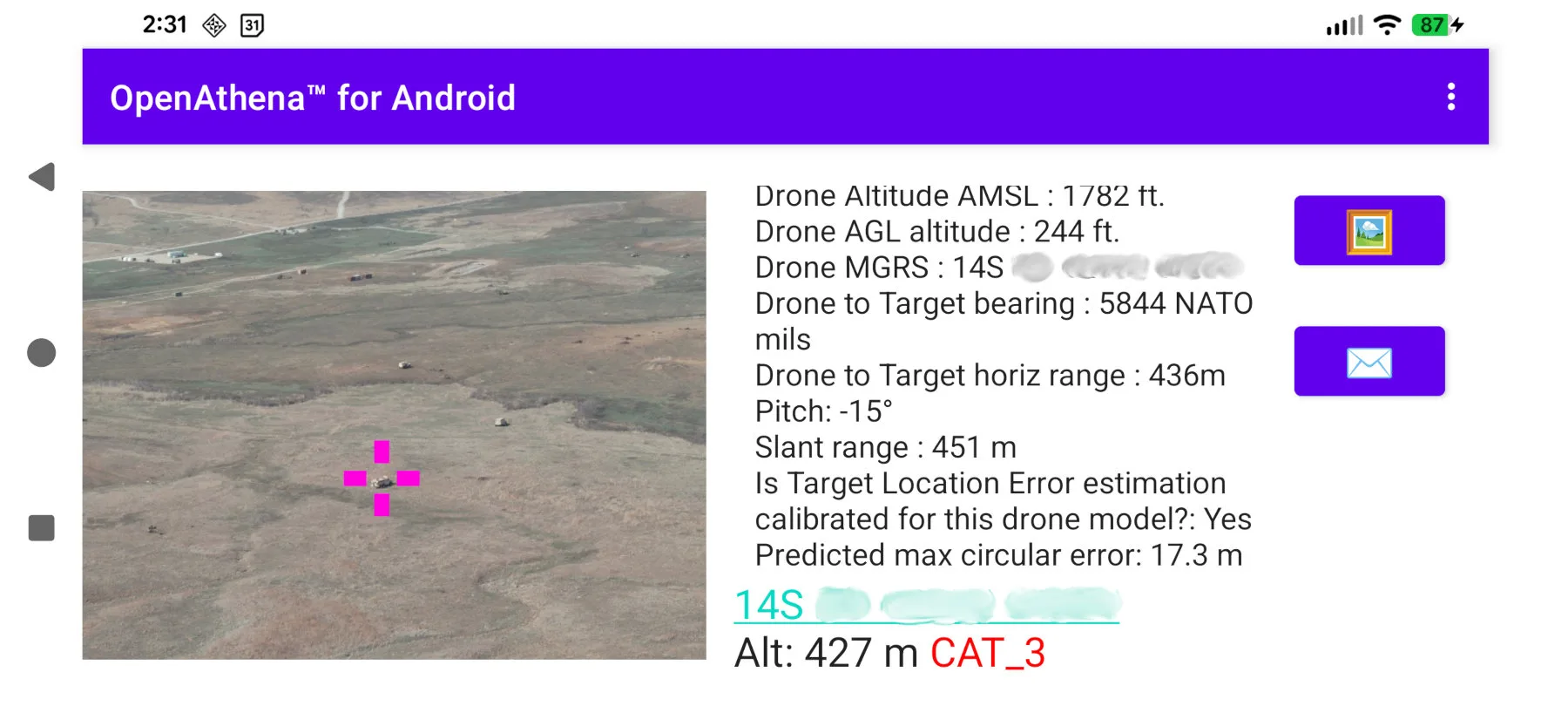
Figure 4: A drone image is loaded into the OpenAthena for Android software and a ground vehicle target is geo-located and transmitted to TAK.
The OpenAthena for Android software provides a simple user interface for operators, allowing dismounted maneuver forces to rapidly process, exploit and disseminate ground targets visible within drone imagery. OpenAthena for Android is compatible with images from a wide variety of sUAS platforms and EO/IR camera hardware.
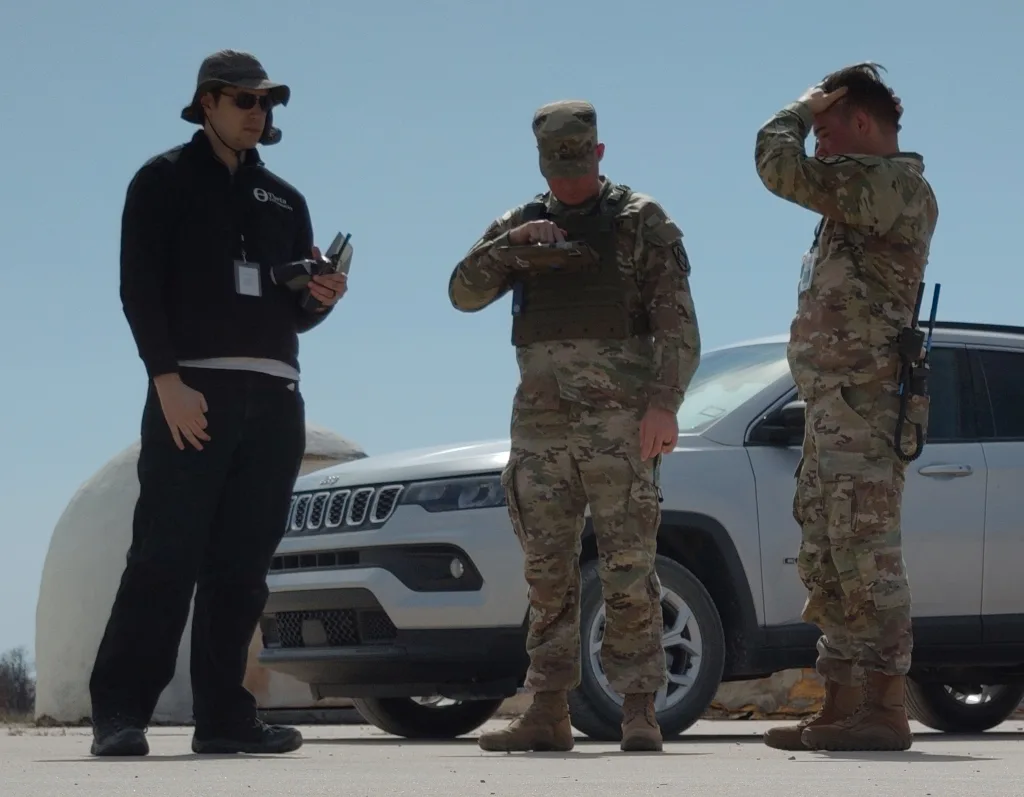
Figure 5: Two Army 13F (Fire Support Specialist) soldiers operate the OpenAthena for Android software on a chest mounted Android device to process, exploit, and disseminate targets from recovered drone imagery. A connected Silvus Streamcaster radio relays target position information from OpenAthena Android directly to the Tactical Operations Center (TOC) and field artillery Fire Direction Center (FDC) for simulated call for fire procedures. The self-healing mesh network and low probability of intercept low probability of detection (LPI/LPD) capabilities of the Streamcaster radios reduce the the radio emission signature of forward units while providing reliable voice comms and network connectivity.
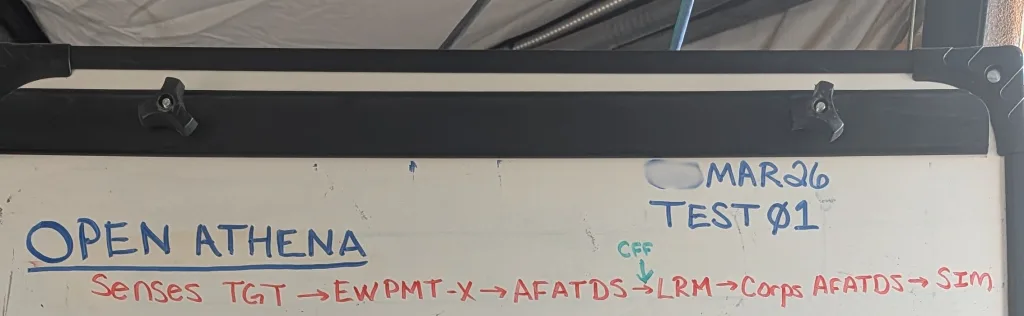
Figure 6: OpenAthena’s sensor-to-shooter kill chain for the experiment is described on a whiteboard. Targets detected from sUAS imagery are sent from OpenAthena to AFATDS through EWPMT-X as an intermediary for a simulated Call For Fire (CFF) procedure.
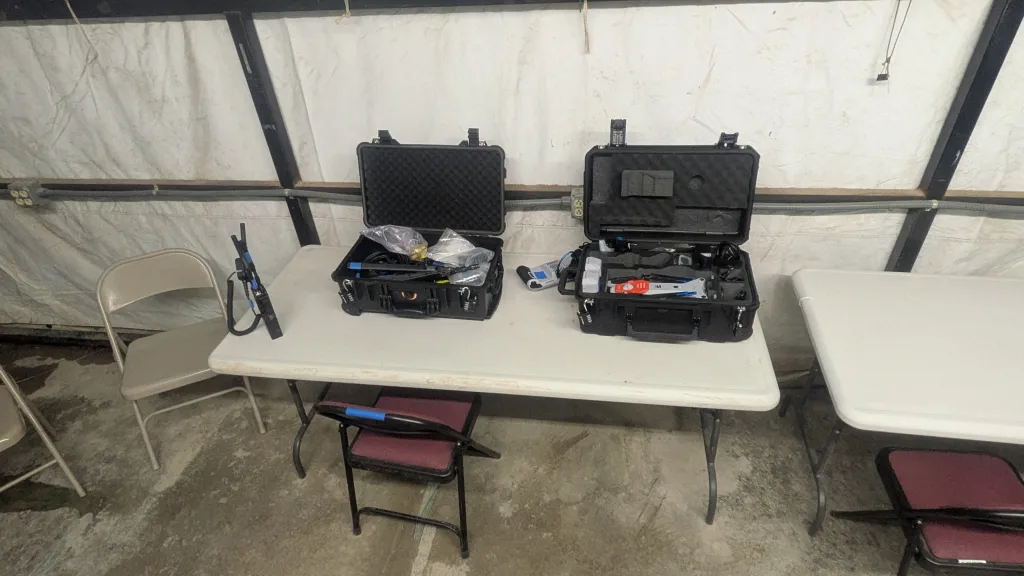
Figure 7: Silvus Streamcaster radio equipment and Skydio X10D sUAS in hardshell carry cases
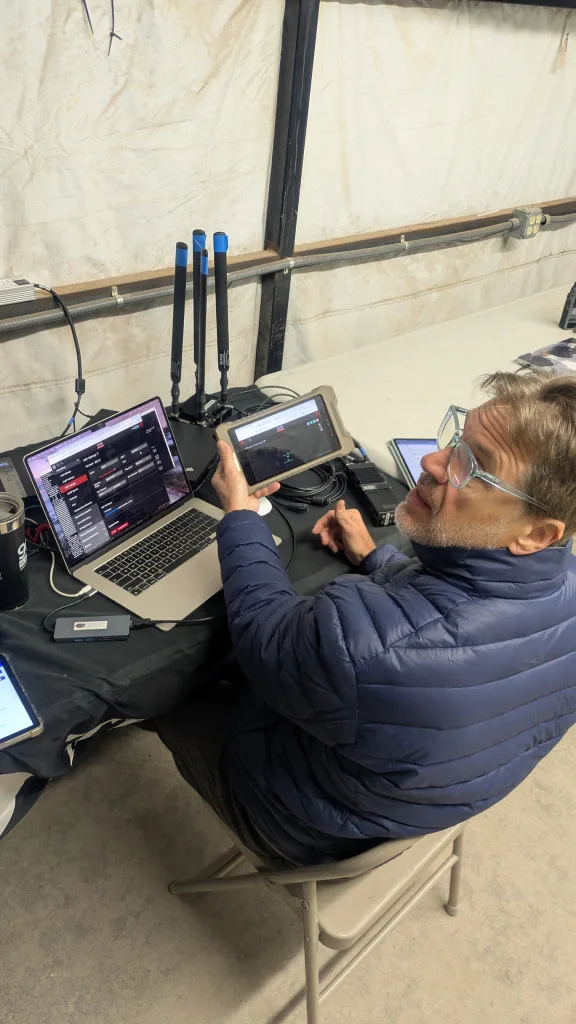
Figure 8: Theta’s co-founder and chief scientist Dr. Robert Krupczak configures Silvus Streamcaster 4200 and 4400 radios from their network web interface. The web interface allows soldiers to monitor the radios’ mesh network topology, signal strength, and configuration throughout the experiment
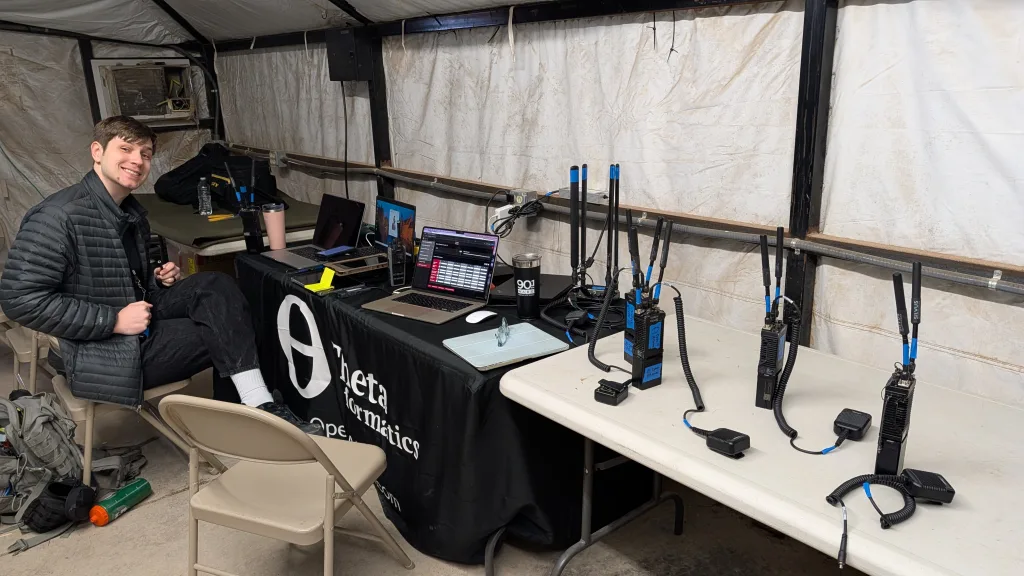
Figure 9: Theta’s President Matthew Krupczak prepares multiple Streamcaster radios, Laptop PC, and Android device hardware for use during the experiment with Theta’s OpenAthena software.
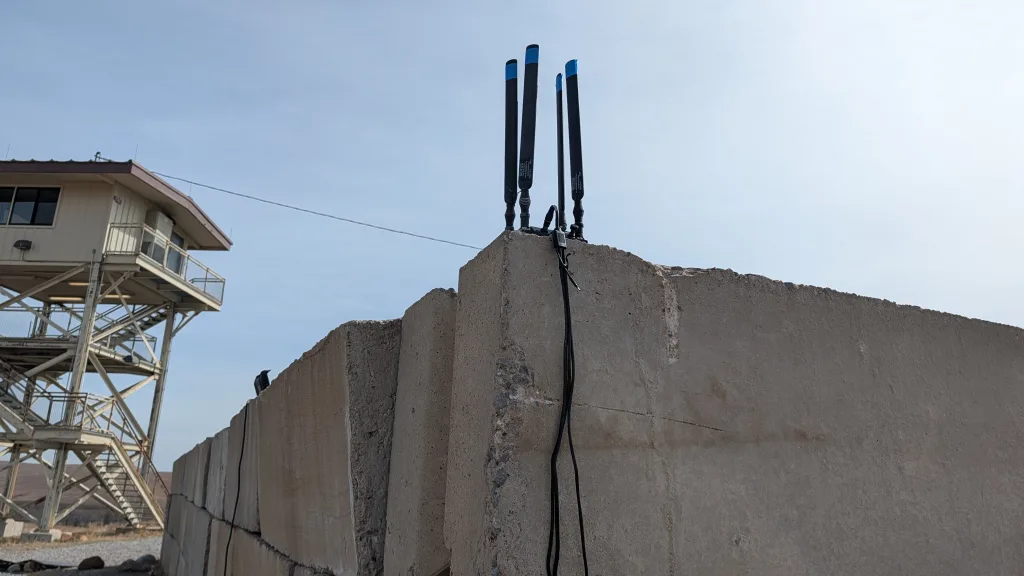
Figure 10: A Silvus Streamcaster 4400 unit is mounted in an elevated position near the TOC. The 4400 unit features both higher directional power output and reception signal gain using Eigen-Beamforming with multiple antennas. This technology reduces the transmit power required for long range tactical communications, reducing the position compromise of forward operators against peer adversary threat profiles.